
Get business pricing on garage and car supplies
- Business-only prices and quantity discounts
- Tax-exempt purchasing
- Multiple users, one account, clear invoices
A browser that feels like a wind tunnel
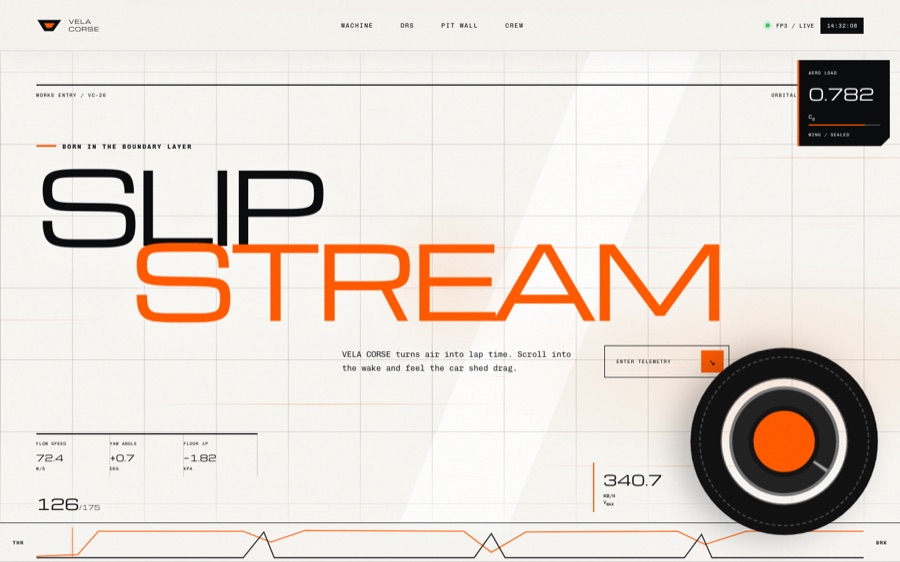
Slipstream is a fictional motorsport-team exhibition piece: Vela Corse is an invented brand, not a real racing outfit. Its site was built by AI, and that’s the story behind the room. Rather than dress up a standard team homepage, the design turns scrolling into a driving sensation, with a technical cutaway car, airflow traces and telemetry all assembled in code.
The signature move is its aero-scroll interaction. As visitors move through a marked DRS section, the page’s scrolling response changes from loaded and deliberate to quicker and lighter. The interface doesn’t merely explain aerodynamic release; it lets the act of browsing echo it.
As an affiliate, we earn on qualifying purchases.
Inside the moving parts
The visual system takes its cues from race-car materials: gloss white inspection spaces alternate with carbon-black performance zones, while signal orange marks active details such as airflow, hardware states and telemetry. Asphalt gray supports the palette without competing for attention. Large Michroma headings read like livery lettering; Chivo Mono gives technical labels and readouts a compact pit-wall character.
Scroll with a DRS state
A wheel-input handler updates a target scroll position, and a continuously running tick eases the page toward it. In the sealed state, lower gain and heavier easing make movement feel resistant. When the DRS marker enters view, the site raises the gain and eases more quickly. The displayed drag coefficient transitions alongside the change, tying the interaction to a piece of visible engineering data.
The response is deliberately not the only way through the page: touch, keyboard input and reduced-motion settings retain native scrolling behavior. The fixed rear-wing overlay also changes state as DRS opens, using layered CSS airfoils and perspective transforms to rotate the flap and bring the assembly into view.
Code as bodywork
The VC-26 cutaway is hand-authored SVG, not a photograph or generated image. Gradients suggest polished paint, a subtle pattern evokes carbon weave, and animated dashed paths map pressure streams and vortices. Visitors can move an interactive pressure probe to inspect local flow readouts. Elsewhere, small SVG traces respond to overall scroll progress, while a CSS-and-DOM pit-stop sequence choreographs crew motion, a wheel change and a timed operation display.
That commitment to code-built visuals gives the site a consistent engineering vocabulary: the car, the aerodynamic effects and the data belong to the same designed system. The result feels less like a brochure decorated with dashboard graphics and more like a technical instrument that happens to tell a team story.
From build to sign-off
The pipeline has three passes: build the experience, critique it mercilessly for weak hierarchy, interaction and responsive behavior, then have an art director certify the refined result. The room’s companion guide documents the interaction, visual tokens and implementation choices, including native-input fallbacks, reduced-motion considerations and checks across screen sizes.
The full build notes live in the room’s design guide.
Want this? Paste this into your AI coding agent
Build a single-page showcase website from this art-direction brief. Work like an elite creative frontend engineer; commit totally to the direction.
BRIEF (room 126 of 175, “slipstream”):
SLIPSTREAM — the works team site of VELA CORSE, a fictional grand-prix outfit. Aesthetic: gloss-white racecar livery meets telemetry engineering. Palette: gloss white, carbon-weave black, signal orange #ff5a00, asphalt grey. Fonts: michroma (display), chivo-mono (telemetry). SIGNATURE: AERO SCROLL — the page has aerodynamic drag: scrolling carries inertia and a live Cd readout; entering the marked DRS ZONE section flips a rear-wing flap across the viewport and scroll resistance visibly drops (easing change you can feel). Telemetry strip-charts (throttle/brake/steering traces) run beneath every section like a data logger. The car exists as a precise SVG cutaway with labeled aero surfaces (bargeboard, diffuser, endplate vortices drawn as spiraling lines). Team radio transcript cards, a pit-stop choreography diagram timed to 2.1s. Unforgettable: feeling the DRS open.STACK: pure HTML/CSS/JS, no build step, no frameworks, no CDNs or external requests of any kind; self-hosted fonts only; every visual is code (CSS/SVG/canvas/WebGL) — no image assets required.
QUALITY BAR: flawless at 390px, 834px and 1440px with zero horizontal overflow; tap targets >= 44px; semantic landmarks, focus-visible styles, body-text contrast >= 4.5:1; prefers-reduced-motion pauses or simplifies heavy animation; rAF loops pause when the tab is hidden; hold 60fps (cap particle counts, avoid layout thrash); rich invented content everywhere — real-sounding names, numbers and program notes, never lorem ipsum; orchestrate one beautiful staggered load moment plus scroll and hover surprises. FORBIDDEN: Inter/Roboto/Arial/system-ui, purple-gradient-on-white, and cookie-cutter hero+cards+footer layouts.
PROCESS: iterate in three documented passes — (1) build plus builder self-critique, (2) merciless external critique finding and fixing at least ten real problems, (3) art-director elevation from good to unforgettable. Screenshot at all three widths every pass and fix everything you can see.
— Original brief by Claude Fable 5 (art director), executed by the FABLE/175 pipeline.
— This room lives at https://fable-25-830.netlify.app/sites/slipstream/
This is the verbatim art-direction brief that produced the room — exposed by the exhibition itself via the “Prompt” link in the room’s footer.
Take it for a lap
Visit the live Slipstream room to explore its code-drawn car and aero-scroll behavior. Then browse all 175 rooms at the hub for more AI-built exhibition pieces.
Visit the live room → · Browse all 175 rooms
FABLE / 175 is a finished exhibition of 175 fundamentally different websites, each built end-to-end by an AI. This article is part of our series walking through it room by room.
Fall Picks
fall essentials
As an affiliate, we earn on qualifying purchases.