
Complete the kit


Get business pricing on garage and car supplies
- Business-only prices and quantity discounts
- Tax-exempt purchasing
- Multiple users, one account, clear invoices
Key Takeaways
- Smart maintenance mode is now standard even on budget models, but the quality of the microprocessor varies greatly, affecting battery life.
- High amperage chargers (20A+) are necessary for jump-starting but can overheat if not managed properly, unlike lower-amp smart chargers.
- Multi-voltage support (6V/12V) is critical for owners of motorcycles, boats, or classic cars, whereas single-voltage units limit future flexibility.
- Repair or desulfation modes are effective for moderately degraded batteries but cannot revive completely dead or physically damaged cells.
- Build quality and cord length are often overlooked differentiators; shorter cords limit parking options, while plastic housings crack under garage conditions.
| PLXX 12V/24V 15A Smart Automotive Battery Charger and Maintainer |  | Best for Broad Lead-Acid Compatibility | Battery voltage: Automatic 12V/24V detection | Maximum current: 15A | Compatible capacity: 4–300Ah | VIEW LATEST PRICE | See Our Full Breakdown |
| NOCO GENIUS1 1A 6V/12V Smart Battery Charger and Maintainer |  | Best Compact Maintainer for Small Batteries | Supported battery voltage: 6V and 12V | Amperage: 1A | Battery types: Lead-acid AGM, gel, flooded, deep-cycle; LiFePO4 | VIEW LATEST PRICE | See Our Full Breakdown |
| Schumacher Electric SC1281 6V/12V Battery Charger and Maintainer with 100A Engine Start |  | Best for Charging Plus Emergency Starting | Battery voltage: 6V/12V | Charging current: 2A–6A | Boost charge: 12A–30A | VIEW LATEST PRICE | See Our Full Breakdown |
| NOCO GENIUS2 2A 6V/12V Smart Battery Charger and Maintainer | 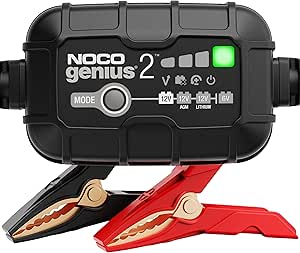 | Best for Small Batteries and Long-Term Maintenance | Supported battery voltage: 6V and 12V | Amperage: 2A | Battery capacity: Up to 40Ah | VIEW LATEST PRICE | See Our Full Breakdown |
| E-FAST 25A Smart 12V/24V Battery Charger and Maintainer with Booster Mode |  | Best High-Output 12V/24V Pick | Output voltage: 12V and 24V | Maximum current: 25A at 12V; 15A at 24V | Current settings: 2A, 8A, 20A, 25A, and Auto | VIEW LATEST PRICE | See Our Full Breakdown |
| NEXPEAK 15A 12V/24V Smart Battery Charger and Maintainer |  | Best for Mixed 12V/24V Batteries | Charging voltage: 12V and 24V | Input voltage: 110V | Charging current: 15A at 12V; 8A at 24V | VIEW LATEST PRICE | See Our Full Breakdown |
| TowerTop 12V Smart Battery Charger and Maintainer, 2A/10A/25A, with Engine Start and Repair Modes |  | Best for Fast 12V Charging and Starting | Output voltage: 12V | Input voltage: 120V AC | Charging settings: 2A, 10A, 25A, and AUTO | VIEW LATEST PRICE | See Our Full Breakdown |
| Schumacher Electric SC1446 10A Battery Charger and 200A Engine Starter |  | Best Wheeled Manual Starter | Charger type: Manual | Battery voltage: 6V and 12V | Engine start: 200A | VIEW LATEST PRICE | See Our Full Breakdown |
| Yourheey 12V/24V 20A Battery Charger and Maintainer with Auto Shutoff, Repair and Winter Modes |  | Best for Multi-Voltage Lead-Acid Fleets | Output voltage: 12V and 24V | Input voltage: 110V | Maximum current: 20A | VIEW LATEST PRICE | See Our Full Breakdown |
| Schumacher Electric SC1280 15A 6V/12V Battery Charger and Maintainer |  | Best for 6V and 12V Automatic Maintenance | Charger type: Fully automatic battery charger and maintainer | Battery voltage: 6V and 12V | Charging rates: 15A at 12V; 2A at 6V | VIEW LATEST PRICE | See Our Full Breakdown |
| NOCO GENIUS5 5A Smart Battery Charger and Maintainer for 6V and 12V Batteries |  | Best for Versatile Smart Charging | Charging current: 5A | Battery voltage compatibility: 6V and 12V | Battery types: Lead-acid and LiFePO4 | VIEW LATEST PRICE | See Our Full Breakdown |
| CRAFTSMAN CMXCESM258 6V/12V 12A Battery Charger and Maintainer |  | Best for Multi-Function Charging | Battery voltage: 6V and 12V | Maximum charging current: 12A | Maintenance current: 3A for 12V; 2A for 6V | VIEW LATEST PRICE | See Our Full Breakdown |
| Schumacher Electric SC1445 Wheeled 6V/12V 250A Battery Charger and Engine Starter |  | Best for Engine Starting | Battery voltage: 6V and 12V | Engine-start output: 250A | Boost modes: 25A and 50A | VIEW LATEST PRICE | See Our Full Breakdown |
More Details on Our Top Picks
PLXX 12V/24V 15A Smart Automotive Battery Charger and Maintainer
The PLXX is a flexible choice for households with several kinds of 12V and 24V lead-acid batteries. It detects the voltage automatically and supports capacities from 4–300Ah, a wider stated range than the compact NOCO GENIUS2, which is designed for batteries up to 40Ah. Its 15A output and fast and trickle modes also give it more charging capacity than either small NOCO charger, while the LCD makes voltage, current, and charge percentage easy to monitor.
The tradeoff is its narrower chemistry support: unlike the E-FAST 25A, the PLXX is specified for lead-acid batteries, not LiFePO4. It is also a substantial 12.8 lb unit, so it suits a garage or workshop better than a glove box. Its repair mode only applies to batteries above 3V, which limits its usefulness for deeply discharged batteries.
Pros:- Automatically detects 12V or 24V lead-acid batteries.
- 15A output and 4–300Ah capacity range suit a broad mix of battery sizes.
- LCD displays voltage, current, and charge percentage.
- Offers fast, trickle, winter, and repair modes with multiple electrical protections.
Cons:- Does not list LiFePO4 compatibility, unlike the E-FAST 25A and NOCO GENIUS2.
- Its 12.8 lb weight makes it less convenient to carry or store in a vehicle.
- Repair mode is specified only for batteries above 3V.
Best for: Owners maintaining a mix of 12V and 24V lead-acid batteries in vehicles, boats, RVs, or lawn equipment who want one higher-output charger.
Not ideal for: LiFePO4 battery owners or drivers seeking a small, portable maintainer; this model is specified for lead-acid batteries and weighs 12.8 lb.
- Battery voltage:Automatic 12V/24V detection
- Maximum current:15A
- Compatible capacity:4–300Ah
- Battery types:AGM, gel, wet/flooded, EFB, calcium, MF, deep-cycle lead-acid
- Charging stages:7
- Display:LCD showing voltage, current, and charge percentage
- Protection:Reverse polarity, short circuit, overcharge, overheat, over-voltage, and over-current
- Dimensions and weight:11.4 × 5.8 × 8.5 in; 12.8 lb
Our verdict“Choose the PLXX for varied 12V and 24V lead-acid batteries when broad capacity support matters more than portability or LiFePO4 compatibility.”
NOCO GENIUS1 1A 6V/12V Smart Battery Charger and Maintainer
The NOCO GENIUS1 is the lineup’s light-duty specialist: its 1A output is suited to maintaining a small battery or slowly charging one between uses, not quickly reviving a larger vehicle battery. It supports both 6V and 12V lead-acid batteries as well as LiFePO4, giving it broader chemistry support than the lead-acid-only PLXX. Temperature compensation adjusts charging to ambient conditions, while Force Mode can address a battery discharged to 0V.
Compared with the NOCO GENIUS2, the GENIUS1 is the more modest choice, with half the current and LiFePO4 support specified only up to 30Ah. That smaller output can mean a long wait on larger batteries. The included clamps and eyelet terminals offer useful connection options, but buyers who need faster charging or a larger battery range should look to the GENIUS2 or a higher-output charger.
Pros:- Supports 6V and 12V lead-acid and LiFePO4 batteries.
- Temperature compensation adjusts charging for ambient conditions.
- Force Mode can charge batteries discharged to 0V.
- Includes both battery clamps and integrated eyelet terminals.
Cons:- 1A output is slow for larger vehicle batteries.
- LiFePO4 support is specified only for batteries up to 30Ah.
Best for: Motorcycle, scooter, lawn-equipment, and small-vehicle owners who need a compact charger for routine maintenance or slow charging.
Not ideal for: Drivers who need to recharge a large car battery quickly or maintain LiFePO4 batteries above 30Ah; the 1A output and stated chemistry capacity are limiting.
- Supported battery voltage:6V and 12V
- Amperage:1A
- Battery types:Lead-acid AGM, gel, flooded, deep-cycle; LiFePO4
- LiFePO4 capacity:Up to 30Ah
- Low-voltage charging:Charges down to 1V; Force Mode supports batteries at 0V
- Charging features:Temperature compensation, pulse desulfation, battery maintenance
- DC cable length:110 in
- Warranty:3 years
Our verdict“Pick the GENIUS1 for small batteries and long-term maintenance, but choose the GENIUS2 or a higher-current model for faster charging.”
Schumacher Electric SC1281 6V/12V Battery Charger and Maintainer with 100A Engine Start
The SC1281 is the most task-diverse pick here for drivers who want more than routine charging. Alongside 6V/12V charging and maintenance, it includes battery testing, reconditioning, and a 100A engine-start function. That starting assistance sets it apart from the NOCO GENIUS2, which focuses on low-current charging and maintenance rather than getting an engine going. Its 2A–6A charging current is better suited to steady charging than rapid replenishment, while boost charging adds another option when a battery needs more current.
This flexibility comes with limits. The listed charging current is far below the PLXX’s 15A and E-FAST’s 25A maximum, so I would not pick the SC1281 for speed. Its LiFePO4 compatibility is limited to 12V batteries, and the provided details do not give a battery-capacity range. It makes the most sense as a garage device for drivers who value starting support and diagnostic functions.
Pros:- Combines charging, maintenance, testing, and reconditioning.
- 100A engine-start function adds emergency starting capability.
- Supports both 6V and 12V batteries.
- Microprocessor-controlled multi-stage charging includes reverse-polarity protection and automatic shutoff.
Cons:- Charging current of 2A–6A is lower than the PLXX and E-FAST maximum outputs.
- LiFePO4 support is specified for 12V batteries only.
- Product details do not state a compatible battery-capacity range.
Best for: Drivers who want a garage charger that can maintain batteries, perform basic testing and reconditioning, and provide engine-start assistance.
Not ideal for: Buyers prioritizing fast charging, a clearly stated large-battery capacity range, or LiFePO4 support beyond 12V batteries.
- Battery voltage:6V/12V
- Charging current:2A–6A
- Boost charge:12A–30A
- Engine start:100A
- Battery types:Standard, AGM, deep-cycle, and 12V LiFePO4
- Functions:Charging, maintaining, testing, reconditioning, and engine starting
- Safety features:Reverse-polarity protection and automatic shutoff
Our verdict“Choose the SC1281 if engine-start assistance and several battery-care functions matter more than high-speed charging.”
NOCO GENIUS2 2A 6V/12V Smart Battery Charger and Maintainer
The GENIUS2 offers a useful step up from the GENIUS1 without leaving the compact-maintainer category. Its 2A output and stated battery capacity up to 40Ah make it a better fit for small vehicle batteries than the 1A GENIUS1, while its support for 6V/12V lead-acid and LiFePO4 batteries gives it more chemistry flexibility than the PLXX. Temperature compensation and pulse charging add battery-care features, and Force Mode can address a battery at 0V.
This is still a slow charger, not a fast recovery option: the E-FAST 25A offers far more current for larger batteries. The GENIUS2 is better suited to smaller batteries and leaving a compatible battery connected for ongoing maintenance. Its stated capacity limit of 40Ah also makes the intended range clear. Clamps, eyelet terminals, and mounting hardware are included, though the accessories do not change its low-output role.
Pros:- Supports 6V and 12V lead-acid and LiFePO4 batteries.
- 2A output offers more charging current than the GENIUS1.
- Temperature compensation, pulse charging, and Force Mode support battery care and recovery.
- Includes clamps, eyelet terminals, and mounting hardware for flexible installation.
Cons:- 2A output is slow for larger batteries compared with the E-FAST 25A.
- Battery capacity is specified up to 40Ah.
Best for: Owners of motorcycles, ATVs, scooters, and other small vehicles who want a 6V/12V charger that can also maintain LiFePO4 batteries.
Not ideal for: Drivers charging large car or truck batteries on a short schedule; 2A output and the 40Ah stated capacity limit favor smaller batteries.
- Supported battery voltage:6V and 12V
- Amperage:2A
- Battery capacity:Up to 40Ah
- Battery types:Lead-acid AGM, gel, SLA, VRLA, flooded, deep-cycle; LiFePO4
- Minimum charging voltage:1V; Force Mode can charge down to 0V
- Input:120–240 VAC
- Cable lengths:72 in AC cable; 80 in DC cable
- Included accessories:Battery clamps, integrated eyelet terminals, mounting bracket, and screws
Our verdict“Choose the GENIUS2 for small batteries that need careful, ongoing maintenance, not for fast charging of a full-size vehicle battery.”
E-FAST 25A Smart 12V/24V Battery Charger and Maintainer with Booster Mode
For buyers who want the most charging current in this group, the E-FAST leads with up to 25A at 12V and 15A at 24V. Five current settings let it serve smaller batteries at 2A as well as larger ones at higher output, unlike the NOCO GENIUS2, whose 2A design is aimed at small batteries and maintenance. It also supports both lead-acid and LiFePO4 batteries, giving it broader chemistry coverage than the PLXX.
The tradeoff is that its added power does not make every mode universal: the 200-second booster works only with 12V batteries, and 24V output tops out at 15A. Its fan and aluminum housing support heat management during charging, but add moving parts and a more substantial charger format than the compact NOCO models. This is the strongest fit for a garage serving different battery sizes, provided the battery voltage and chemistry match its supported modes.
Pros:- Provides up to 25A at 12V and 15A at 24V.
- Five current settings accommodate different charging needs.
- Supports lead-acid battery types and LiFePO4.
- Aluminum housing, cooling fan, seasonal modes, and safety protections support higher-output operation.
Cons:- Booster mode is limited to 12V batteries.
- 24V output is limited to 15A.
- Built-in cooling fan makes it less suited to buyers seeking a silent compact maintainer.
Best for: Owners of cars, trucks, boats, or equipment with compatible 12V/24V lead-acid or LiFePO4 batteries who want adjustable, higher-current charging.
Not ideal for: Buyers seeking a tiny, silent maintainer or those needing booster assistance on 24V batteries; the booster is 12V-only and the charger has a cooling fan.
- Output voltage:12V and 24V
- Maximum current:25A at 12V; 15A at 24V
- Current settings:2A, 8A, 20A, 25A, and Auto
- Battery compatibility:Lead-acid AGM, GEL, SLA, flooded, EFB, and LiFePO4
- Charging process:8 stages
- Booster mode:200 seconds; 12V batteries only
- Housing and cooling:Aluminum alloy; built-in fan
- Dimensions and weight:8.5 × 4.9 × 7.5 in; 3.7 lb
Our verdict“Pick the E-FAST for adjustable, high-output charging across compatible 12V and 24V batteries, but not for 24V booster starting.”
NEXPEAK 15A 12V/24V Smart Battery Charger and Maintainer
The NEXPEAK earns this role through its unusual combination of 12V and 24V support with compatibility for both lead-acid and LiFePO4 batteries. Its 15A 12V output can charge faster than a low-current maintainer, while the 9-stage process, trickle mode, and pulse repair add options for ongoing care. The LCD shows charging details, giving more feedback than a basic charger, and multiple safety protections add reassurance during connection and charging. Compared with the Yourheey 20A, the NEXPEAK is the better fit for buyers who need lithium compatibility, though it has a lower listed maximum current. It is not a rescue tool for deeply depleted batteries: it cannot charge below 0.3V or revive a completely dead battery, and it needs an AC outlet.
Pros:- Supports 12V and 24V lead-acid and LiFePO4 batteries.
- Combines charging, trickle maintenance, and pulse-repair functions.
- LCD displays voltage, current, temperature, and charge percentage.
- Includes reverse-polarity, overcurrent, overcharge, and short-circuit protection.
Cons:- Cannot charge batteries below 0.3V or restore completely dead batteries.
- Requires an AC power outlet.
Best for: Owners of both 12V and 24V vehicles or equipment who want one outlet-powered charger for lead-acid and LiFePO4 batteries.
Not ideal for: Drivers trying to revive a completely dead or sub-0.3V battery, or anyone needing a portable charger that works without household AC.
- Charging voltage:12V and 24V
- Input voltage:110V
- Charging current:15A at 12V; 8A at 24V
- Trickle current:1.75A
- Charging stages:9
- Compatible batteries:Lead-acid and LiFePO4
- Connector:Cable clamps/alligator clips
- Cord length:8.9 ft
- Weight:2.4 lb
Our verdict“Choose the NEXPEAK if you need broad battery-chemistry and voltage compatibility with useful charge-status feedback, but not dead-battery recovery.”
TowerTop 12V Smart Battery Charger and Maintainer, 2A/10A/25A, with Engine Start and Repair Modes
The TowerTop is the strongest match here for 12V lead-acid owners who want both adjustable charging rates and an engine-start assist. Its 25A maximum gives it more charging muscle than the Schumacher SC1280’s 15A 12V rate, while the 100A start function can help when a compatible vehicle needs more than routine charging. Automatic charging, winter mode, desulfation, and maintenance add flexibility for seasonal use. The tradeoff is a narrower battery-chemistry remit: unlike the NEXPEAK, it is specified for sealed lead-acid types rather than LiFePO4. Its repair mode also cannot revive a completely drained battery, so the start function should not be mistaken for a guaranteed fix for a failed battery. The LCD and safety protections help make its more capable feature set easier to manage.
Pros:- Offers 2A, 10A, 25A, and automatic charging options.
- Includes a 100A engine-start function.
- Provides winter, repair, desulfation, and maintenance modes.
- LCD status display and multiple built-in safety protections.
Cons:- Designed for 12V sealed lead-acid batteries, not lithium or 24V systems.
- Repair mode cannot restore completely drained batteries.
Best for: Drivers with 12V lead-acid vehicles who want selectable charging speeds, storage maintenance, and an engine-start function in one unit.
Not ideal for: Owners of LiFePO4 batteries or 24V systems, and anyone expecting repair mode to revive a completely drained battery.
- Output voltage:12V
- Input voltage:120V AC
- Charging settings:2A, 10A, 25A, and AUTO
- Maximum charging current:25A
- Engine-start current:100A
- Compatible batteries:STD, AGM, GEL, wet, MF, EFB, calcium, and deep-cycle 12V sealed lead-acid
- Charging stages:8
- Dimensions:7.68 x 10.04 x 4.92 in
- Weight:5 lb
Our verdict“Pick the TowerTop for a feature-rich 12V lead-acid setup where faster charging and engine-start assistance matter more than lithium or 24V support.”
Schumacher Electric SC1446 10A Battery Charger and 200A Engine Starter
The SC1446 is built for a different job from automatic maintainers: it pairs a 200A engine start with manual charging and boost modes in a wheeled steel housing. That makes it a practical garage or workshop unit when moving a heavier charger between vehicles matters, and its 6V/12V support covers more than the TowerTop’s 12V-only design. The analog ammeter and 135-minute timer give the operator visible control, but they also mean charging needs active monitoring rather than the hands-off maintenance offered by the Schumacher SC1280. Its 10A charge mode is less suited to quick routine charging than the TowerTop’s 25A setting, while the boost modes serve shorter, more immediate needs. Choose it for starting and controlled manual charging, not unattended battery care.
Pros:- Combines a 200A engine start with 10A charging and boost modes.
- Supports 6V and 12V standard, AGM, gel, and deep-cycle batteries.
- Wheels and a retractable handle make the steel unit easier to move.
- Analog ammeter and timer provide direct control over manual charging.
Cons:- Manual charging requires the operator to monitor the process.
- The 135-minute timer limits each timed charging session.
- Its wheeled steel design is less convenient for compact storage than smaller automatic chargers.
Best for: Home mechanics and small workshops that need a movable 6V/12V charger with strong engine-start and boost functions.
Not ideal for: Drivers seeking an automatic maintainer for unattended charging or a compact unit that is easy to store and carry.
- Charger type:Manual
- Battery voltage:6V and 12V
- Engine start:200A
- Boost modes:40A at 12V; 20A at 6V/12V
- Charge mode:10A
- Compatible batteries:Standard, AGM, gel, and deep-cycle
- Timer:Up to 135 minutes
- Mobility:Wheels and retractable handle
- Cable lengths:6 ft booster cable and 6 ft power cord
Our verdict“Choose the SC1446 for a garage where manual control, mobility, and engine-start capability take priority over automatic maintenance.”
Yourheey 12V/24V 20A Battery Charger and Maintainer with Auto Shutoff, Repair and Winter Modes
The Yourheey’s appeal is straightforward: it supports 12V and 24V lead-acid batteries, detects system voltage automatically, and stops charging when the battery is full. That combination suits owners maintaining different vehicles or equipment without selecting a charger dedicated to each voltage. Its listed 20A maximum, pulse repair, and winter mode give it a more active charging feature set than a simple maintainer. Compared with the NEXPEAK, though, the Yourheey gives up LiFePO4 compatibility; buyers with lithium batteries should choose the NEXPEAK instead. It also weighs 12.5 pounds, a notable burden for a charger described as compact, and the product data does not list a charging-current breakdown by voltage. This is best treated as a lead-acid-only garage option, not a lightweight travel charger.
Pros:- Supports 12V and 24V lead-acid systems with automatic voltage detection.
- Automatically stops charging when the battery is full.
- Includes pulse-repair and winter modes.
- Compatible with several lead-acid types, including AGM, GEL, EFB, and deep-cycle.
Cons:- Not compatible with lithium or LiFePO4 batteries.
- Listed weight of 12.5 pounds makes it less portable than lighter options.
- The supplied specifications do not state separate charging-current rates for 12V and 24V.
Best for: Owners of cars, trucks, RVs, boats, or lawn equipment with 12V and 24V lead-acid batteries who want automatic shutoff and winter charging.
Not ideal for: LiFePO4 owners or buyers who need a lightweight charger to carry between vehicles.
- Output voltage:12V and 24V
- Input voltage:110V
- Maximum current:20A
- Compatible batteries:Lead-acid: AGM, GEL, flooded, EFB, calcium, maintenance-free, and deep-cycle
- Lithium compatibility:Not compatible
- Functions:Automatic voltage detection and shutoff, pulse repair, and winter mode
- Number of ports:1
- Dimensions:3.15 x 7.09 x 2.36 in
- Weight:12.5 lb
Our verdict“Choose the Yourheey if you maintain multiple 12V and 24V lead-acid batteries and do not need lithium compatibility or easy portability.”
Schumacher Electric SC1280 15A 6V/12V Battery Charger and Maintainer
The SC1280 is a sensible pick for owners who want automatic charging across 6V and 12V batteries without the manual oversight required by the SC1446. It supports standard, AGM, gel, and deep-cycle batteries, then adds maintaining, testing, and restoring functions in one unit. Microprocessor control, automatic voltage detection, desulfation, and reverse-clamp protection suit routine garage use where clear, guarded operation matters more than engine-start power. Its 15A rate applies to 12V batteries; the 6V mode is only 2A, so buyers with frequent 6V charging should expect a slower pace. Compared with the TowerTop, it offers 6V compatibility and more explicit testing functions, but lacks the listed 100A start assist and 25A charging option. It also needs AC power and has short six-foot leads.
Pros:- Charges and maintains both 6V and 12V batteries.
- Combines charging, maintaining, testing, and restoring functions.
- Microprocessor-controlled charging includes automatic voltage detection and desulfation.
- Reverse-clamp protection helps prevent operation with incorrectly connected clamps.
Cons:- The 6V charging rate is 2A, much lower than its 15A 12V rate.
- Requires AC power and has six-foot power and booster cables.
- Does not list an engine-start function, unlike the TowerTop and SC1446.
Best for: Owners of 6V and 12V standard, AGM, gel, or deep-cycle batteries who want automatic charging, maintenance, and battery checks.
Not ideal for: Drivers who need engine-start assistance, a faster 6V charge, or longer cables for reaching distant outlets and batteries.
- Charger type:Fully automatic battery charger and maintainer
- Battery voltage:6V and 12V
- Charging rates:15A at 12V; 2A at 6V
- Maintain mode:3A
- Compatible batteries:Standard, AGM, gel, and deep-cycle
- Functions:Charging, maintaining, testing, and restoring
- Safety feature:Reverse-clamp protection
- Power cord length:6 ft
- Booster cable length:6 ft
Our verdict“Pick the SC1280 for automatic 6V/12V charging and maintenance, but choose another model if engine starting or faster 6V charging is a priority.”
NOCO GENIUS5 5A Smart Battery Charger and Maintainer for 6V and 12V Batteries
The NOCO GENIUS5 is a strong fit for owners who need one smart charger for both 6V and 12V batteries, including lead-acid and LiFePO4 types. Its 5A output sits between slower maintainers such as the NOCO GENIUS2 and higher-current options like the CRAFTSMAN CMXCESM258, making it more suited to routine charging than either long-term trickle maintenance or fast recovery. Temperature compensation adapts charging to surrounding conditions, while Force Mode can address batteries that have fallen to very low voltage. Pulse desulfation and long-term monitoring add useful support for stored vehicles. The tradeoff is that the feature set requires more judgment than a basic maintainer, and the listed eight-hour charge estimate lacks a stated battery size or test conditions. Check the charging instructions before relying on that estimate.
Pros:- Supports 6V and 12V lead-acid and LiFePO4 batteries.
- Temperature compensation adapts charging to ambient conditions.
- Force Mode can charge batteries with extremely low voltage.
- Includes clamps, eyelet terminals, and mounting hardware for different connection needs.
Cons:- The listed 12V output specification may leave 6V charging capability unclear to some buyers.
- The eight-hour charge estimate does not specify battery capacity or charging conditions.
Best for: Owners of cars, motorcycles, boats, or recreational vehicles who need a mid-output smart charger for both 6V and 12V lead-acid or LiFePO4 batteries.
Not ideal for: Drivers who want a high-current charger for faster recovery, or buyers who prefer a very simple maintainer with fewer modes to interpret.
- Charging current:5A
- Battery voltage compatibility:6V and 12V
- Battery types:Lead-acid and LiFePO4
- Maximum battery capacity:Up to 120Ah
- Charging features:Temperature compensation, Force Mode, pulse desulfation, and maintenance
- Included cables:72-inch AC cable and 80-inch DC cable
- Included connections:Battery clamps and eyelet terminals
- Warranty:3 years
Our verdict“Choose the GENIUS5 if you want a versatile, mid-output smart charger with recovery and maintenance features across 6V and 12V batteries.”
CRAFTSMAN CMXCESM258 6V/12V 12A Battery Charger and Maintainer
The CRAFTSMAN CMXCESM258 earns its place for buyers who want charging, maintenance, testing, and restoration in one unit. Its 12A maximum charging current gives it more charging headroom than the 5A NOCO GENIUS5, while lower 3A and 2A charge/maintain settings serve 12V and 6V batteries respectively. A digital display and push-button controls make the operating status easier to follow than a basic analog charger, and reverse-hookup protection helps guard against a common connection mistake. It also supports standard, AGM, and deep-cycle batteries, plus 12V LiFePO4. That lithium limitation matters: unlike the GENIUS5, it is not specified for 6V lithium batteries. Its 12-foot combined cable reach is practical, though less freedom than a longer-reach setup may suit awkward parking arrangements.
Pros:- Combines charging, maintenance, testing, and restoration functions.
- Offers up to 12A charging with lower-current maintenance settings.
- Digital display, LED indicators, and reverse-connection protection aid everyday operation.
- Supports standard, AGM, deep-cycle, and 12V LiFePO4 batteries.
Cons:- LiFePO4 compatibility is limited to 12V batteries.
- The 12A charging mode is distinct from the lower-current maintenance settings, so it is not a 12A maintainer.
Best for: Vehicle and equipment owners who want one charger to handle several common battery types and provide charging, maintenance, testing, and restoration functions.
Not ideal for: Owners who need lithium support beyond 12V LiFePO4, or shoppers seeking a dedicated high-current engine-start function.
- Battery voltage:6V and 12V
- Maximum charging current:12A
- Maintenance current:3A for 12V; 2A for 6V
- Compatible battery types:Standard, AGM, deep-cycle, and 12V LiFePO4
- Functions:Charging, maintenance, testing, and restoration
- Display and controls:Digital display, LED indicators, and push-button controls
- Combined cable reach:12 feet
- Warranty:Two-year limited warranty
Our verdict“Pick the CRAFTSMAN if you want a clearly displayed, multi-function charger with more charging current than the NOCO GENIUS5 and do not need broader lithium compatibility.”
Schumacher Electric SC1445 Wheeled 6V/12V 250A Battery Charger and Engine Starter
The Schumacher SC1445 serves a different job from smart maintainers: it pairs a manual charger with a 250A engine-start mode for drivers who want starting assistance as well as battery charging. Its 25A and 50A boost settings offer additional high-output options, while the 10A charging mode handles routine charging. Compared with the CRAFTSMAN CMXCESM258, the SC1445 puts less emphasis on automatic functions and battery testing, but brings much stronger engine-start capability. The analog ammeter and 135-minute timer give the operator direct control; that can suit experienced owners, but it also means the charging process needs attention rather than being left to an automatic maintainer. A steel case, wheels, and retractable handle help move the unit, though it remains a bulky choice for compact storage.
Pros:- Combines 250A engine starting with 25A and 50A boost modes.
- Supports 6V and 12V batteries across standard, AGM, gel, and deep-cycle types.
- Wheels and a retractable handle aid movement around a garage or workshop.
- Analog ammeter and timer provide direct charging control.
Cons:- Manual operation requires the user to monitor and control charging.
- The heavy-duty steel construction and wheeled format take up more storage space than compact smart chargers.
Best for: Drivers with larger vehicles or equipment who want a wheeled 6V/12V charger that can also provide substantial engine-start assistance.
Not ideal for: Owners seeking an automatic, low-supervision maintainer for long-term battery storage or a compact charger for a small garage.
- Battery voltage:6V and 12V
- Engine-start output:250A
- Boost modes:25A and 50A
- Charging mode:10A
- Compatible battery types:Standard, AGM, gel, and deep-cycle
- Timer:Up to 135 minutes
- Display:Analog ammeter
- Construction and mobility:Heavy-duty steel case, wheels, and retractable handle
Our verdict“Choose the SC1445 if engine-start assistance and boost modes matter more than automatic charging and compact storage.”
How We Picked
I evaluated these thirteen chargers based on three core pillars: charging efficiency, safety architecture, and usability. Charging efficiency was judged by the ability to handle various battery chemistries (lead-acid, AGM, gel) and the accuracy of the automatic shut-off features. I looked for units that provide clear status indicators rather than vague LED blinks. Safety architecture was critical; I prioritized models with spark-proof technology, reverse polarity protection, and overcharge prevention, as these features protect both the vehicle’s electronics and the user. Finally, usability considered the clarity of the interface, the durability of the clamps, and the practicality of the cord length. Products that offered complex menus without clear instructions were ranked lower than intuitive, plug-and-play designs.Factors to Consider When Choosing Car Battery Chargers
Selecting a battery charger is not just about picking the highest amperage number on the box. The right choice depends on your specific usage patterns, vehicle type, and garage setup. Here are the key factors to weigh before purchasing.Amperage vs. Charging Speed
Amperage dictates how quickly a charger can replenish energy, but higher is not always better. A 1-amp or 2-amp charger is ideal for long-term maintenance because it gently tops off the battery without generating excessive heat, which can damage plates over time. In contrast, a 10-amp or 20-amp charger is designed for rapid recovery of a deeply discharged battery or for jump-starting assistance. If you only need to keep a weekend car ready, a high-amp unit is overkill and potentially harmful if left connected too long without smart cutoffs. Conversely, if you frequently find yourself with a dead battery, a low-amp maintainer will take days to recover it, making a mid-range or high-amp unit more practical.
Smart Features and Battery Chemistry Compatibility
Modern vehicles use various battery types, including flooded lead-acid, AGM (Absorbent Glass Mat), and Gel. A basic charger might apply the same voltage to all, which can undercharge AGM batteries or overcharge flooded ones. Smart chargers use microprocessors to detect the battery type and apply the correct charging profile, extending battery life. Look for units explicitly labeled as compatible with AGM and Gel, especially if you drive a newer car with start-stop technology, which typically uses AGM batteries. Ignoring this compatibility can lead to premature battery failure, negating the benefit of the charger.
Engine Start Capability vs. Pure Charging
Some devices are hybrid units that function as both chargers and jump starters, while others are dedicated maintainers. Jump-start capable chargers deliver a high burst of current (often 100A to 250A) to crank the engine, which is useful if you lack jumper cables or a second vehicle. However, these units are typically heavier, bulkier, and more expensive. If you already own a portable lithium jump starter or jumper cables, a dedicated smart charger is often a better investment because it focuses on long-term battery health rather than emergency starting. Decide whether you need a tool for recovery or a tool for maintenance.
Desulfation and Repair Modes
Lead-acid batteries degrade over time due to sulfation, where lead sulfate crystals harden on the plates, reducing capacity. Many premium chargers include a repair or recondition mode that uses high-frequency pulses to break down these crystals. This feature is highly beneficial for older vehicles or batteries that have sat unused for months, potentially restoring lost capacity. However, it is not a magic fix; if the internal plates are physically corroded or shorted, no charger can repair them. Use this mode as a preventive measure or for mild degradation, not as a last resort for a dying battery.
Build Quality and Cord Management
Garage environments are harsh, with temperature fluctuations and potential physical impacts. Plastic housings can crack if dropped, while rubberized or metal-reinforced cases offer better durability. Pay attention to the cord length; many budget chargers come with short power cords (2-3 feet), forcing you to use an extension cord, which can introduce resistance and safety hazards. Longer, heavy-gauge cables with robust alligator clamps ensure a solid connection and reduce the risk of spark or heat buildup at the terminal. A well-built charger is an investment that lasts years, whereas a flimsy one may fail after a few seasons of use.