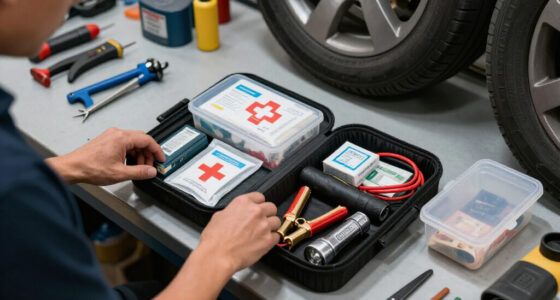
This checklist is for drivers who want to keep car batteries ready for everyday use, seasonal storage, or an unexpected no-start. It can also help you spot when a product name may not match the job you have in mind. Check the intended use before choosing any item.

Get business pricing on garage and car supplies
- Business-only prices and quantity discounts
- Tax-exempt purchasing
- Multiple users, one account, clear invoices
The sections follow common battery-care roles: charging, jump-starting, testing, cleaning terminals, maintaining charge, and holding a battery in place. Each pick is listed under its assigned slot, with practical notes to guide your review. Match the tool to the task and the vehicle.
Use the look-for points as a short comparison checklist, then confirm fit and compatibility in the product details and your vehicle’s documentation. The names alone do not establish specifications beyond the wording shown. Verify before buying, especially for electrical connections, battery size, and mounting.
Battery Charger
A charger belongs in a battery-care kit when the goal is to replenish a battery using an appropriate charging setup. The listed pick is a Schumacher Electric wheeled 6/12V 250A car battery starter/charger. Its name indicates wheeled construction and 6/12V labeling, but it does not establish which battery chemistries, vehicle applications, or charging modes are supported. Confirm compatibility in the product documentation before connecting it.
A common buying mistake is treating a starter/charger as interchangeable with every charger or maintainer. Check the instructions for supported battery types, voltage selection, connection order, and any limits on use. Consider whether the wheeled format suits your storage space and where you expect to work; also confirm that the cables and clamps can reach the battery location. Read the operating guidance and follow the vehicle maker’s battery service instructions. If your needs are mainly long-term storage, compare the separate maintainer option rather than assuming a charger is designed for continuous connection.
What to look for:
- Confirm the supported battery chemistry and vehicle applications in the manual.
- Check that the 6/12V options match the battery and intended use.
- Review connection order, operating instructions, and safety guidance.
- Measure storage space and consider the wheeled format.
- Confirm cable and clamp reach for the battery location.
Schumacher Electric Wheeled 6/12V 250A Car Battery Starter/Charger – SC1445
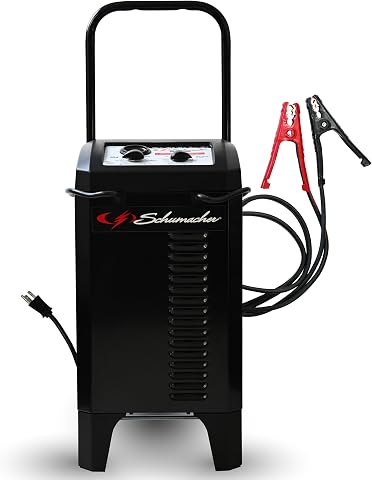
The Schumacher SC1445 is a versatile 2-in-1 wheeled battery charger and engine starter designed for automotive, marine, and power sport batteries. It provides peak power for engine starting, precise manual charging control, and supports various battery types including AGM and gel, making it ideal for both quick boosts and regular maintenance.
Pros:
- Powerful 250-amp engine start for large engines
- Manual control with adjustable timer for precise charging
- Supports multiple battery types including AGM and gel
- Heavy-duty steel construction for durability
Cons:
- Manual operation may require some user knowledge
- Relatively heavy and bulky for portable use
Best for: Drivers seeking a wheeled 6/12V starter/charger
Not ideal for: Shoppers who need a compact or storage-focused maintainer
Bottom line: Verify supported batteries and operating instructions before choosing this wheeled starter/charger.
Jump Starter
A jump starter is intended to help address a no-start situation without relying on another vehicle’s battery. The pick is the NOCO Boost GB70 2000A UltraSafe 12V Lithium Jump Starter. Its name identifies a 12V lithium jump starter, but it does not specify which engine sizes, battery conditions, or vehicle types it supports. Check the application guidance against your vehicle before relying on it.
Do not assume that a jump starter’s stated amperage alone establishes suitability. Review the maker’s compatibility information, included connections, instructions, and any storage or charging requirements. Consider where it will be kept and whether you can access it when needed; a device stored away from the vehicle may not be useful during a roadside no-start. Learn the connection steps ahead of time and follow the product and vehicle instructions. This pick’s name describes a jump starter, not a battery charger or long-term maintainer, so select separate equipment if those are your goals.
What to look for:
- Confirm vehicle and engine compatibility in the product guidance.
- Check the included clamps and connection instructions.
- Review storage and recharge requirements.
- Choose a storage location that remains accessible when needed.
- Follow both the product and vehicle maker’s procedures.
NOCO Boost GB70 2000A UltraSafe 12V Lithium Jump Starter

The NOCO Boost GB70 is a 12V lithium jump starter with 2000A peak output, rated for gasoline engines up to 8.0L and diesel engines up to 6.0L. It includes spark-proof and reverse-polarity protection, a USB power bank, and a 400-lumen LED flashlight with seven modes.
Pros:
- 2000A peak output and up to 40 starts per charge
- Spark-proof and reverse-polarity protection
- Functions as a power bank and includes a 400-lumen flashlight
- IP65-rated housing with rubberized over-molding
Cons:
- Weighs 5 pounds
- Recharge time is 6 hours
Best for: Drivers looking for a named 12V jump starter
Not ideal for: Shoppers seeking a charger or long-term maintainer
Bottom line: Check vehicle compatibility and connection steps before keeping this jump starter in your kit.
Battery Tester
A tester can help you assess battery condition as part of routine care or when a starting problem appears. The listed product is an AUTOOL 0–80V automotive battery tester with built-in printer. The name gives a voltage range and indicates a printer, but does not explain supported test types, battery chemistries, or how to interpret results. Review the test functions before treating it as a fit for your vehicle.
A frequent mistake is buying a tester based only on its voltage range or assuming a printed result provides a diagnosis by itself. Check the product documentation for battery compatibility, connection requirements, test procedure, and the meaning of displayed or printed readings. Consider whether the printer feature suits your recordkeeping needs and confirm any supplies or setup it requires. Use the vehicle guidance when interpreting results, and seek qualified service if you are unsure what a reading means. A tester measures; its name does not indicate that it charges or repairs a battery.
What to look for:
- Confirm supported battery types and test functions.
- Check that the stated voltage range covers the intended application.
- Review connection and testing procedures.
- Understand how the device presents and prints results.
- Confirm any setup or supplies needed for the printer.
AUTOOL 0–80V Automotive Battery Tester with Built-In Printer

Tests battery health, cranking, charging, and load, with a 30–2000 CCA range for flooded, AGM, EFB, and gel lead-acid batteries. It includes leakage-current monitoring, a color backlit display, built-in test record storage, and a thermal printer for reports.
Pros:
- Combines battery, cranking, charging, and load tests with leakage-current monitoring.
- Built-in printer and data storage support test reporting and record review.
- Backlit color display is designed for readability in dim work areas.
- Reverse-polarity protection helps guard against incorrect clamp connections.
Cons:
- Supports lead-acid battery types; other battery chemistries are not listed.
- The stated maximum operating voltage is 80 V.
Best for: Users who want a tester with a built-in printer
Not ideal for: Shoppers seeking a charger or a repair tool
Bottom line: Confirm test compatibility and learn how to interpret results before relying on this tester.
Battery Terminal Brush
Terminal cleaning is a distinct maintenance task: a brush should be appropriate for the area being cleaned and the access available around the battery. The assigned pick is a battery-powered ride-on commercial floor scrubber with a 22-inch brush. Its name describes floor-cleaning equipment, not a battery terminal brush. Check the product category carefully before considering it for this checklist slot.
A common buying mistake is choosing by a shared word such as “battery” or “brush” without confirming the tool’s intended surface and scale. The listed description points to a ride-on floor scrubber, so it does not establish that the brush is suitable for battery terminals or confined automotive work. For terminal care, look for a product explicitly described for battery terminals and follow its instructions alongside the vehicle maker’s service guidance. Match the tool to the contact area, and do not use equipment for a different purpose based only on its name. Confirm access, materials, and handling instructions before working near a battery.
What to look for:
- Choose a product explicitly intended for battery terminal cleaning.
- Check brush size and access around the installed battery.
- Review material and use instructions for the terminal surface.
- Follow vehicle service guidance for battery-area work.
- Confirm the product category matches automotive terminal care.
Battery-Powered Ride-On Commercial Floor Scrubber, 22-Inch Brush

This battery-powered ride-on scrubber has a 22-inch cleaning path, a 31.5-inch squeegee, and dual tanks for commercial floor cleaning. It operates at 60 dB, handles inclines up to 20 degrees, and includes front and rear lights, a backup alarm, and a hard-floor brush.
Pros:
- Wide scrubbing path and squeegee support coverage and water collection.
- Large dual tanks reduce the need for frequent refills.
- Quiet operation is suited to noise-sensitive environments.
- Lights and a backup alarm support visibility and safety.
Cons:
- A full charge takes 7–8 hours.
- Runtime is limited to 3–4 hours per charge.
Best for: A commercial floor-cleaning task, based on its name
Not ideal for: Battery terminal cleaning in an automotive setting
Bottom line: The listed product name describes a floor scrubber, so verify the pick before using it for terminal care.
Battery Maintainer
A maintainer is useful when a compatible battery needs charge support during periods of limited use. The listed pick is the NOCO Genius10 10A 6/12V smart battery charger, trickle charger and maintainer. Its name identifies several charging roles and 6/12V labeling, but it does not establish support for every battery type or storage situation. Verify the battery match and the intended operating mode in the product instructions.
One common mistake is leaving a charger connected for extended periods without confirming that its instructions allow that use for the specific battery. Check supported chemistries, voltage selection, connection requirements, and how the product manages charging or maintenance. Confirm the battery can remain connected in the planned setting and follow any vehicle guidance for storage. Use the manual’s setup rather than inferring behavior from the words “smart” or “maintainer.” If you need rapid charging or starting assistance, compare those tasks separately; this pick’s name alone does not define its performance for either.
What to look for:
- Confirm supported battery chemistries and applications.
- Verify the correct 6/12V setting for the battery.
- Review instructions for extended or storage use.
- Check connection requirements and charging modes.
- Follow vehicle guidance for a battery left connected.
NOCO Genius10 10A 6/12V Smart Battery Charger, Trickle Charger & Maintainer

The NOCO Genius10 is an all-in-one battery charger, maintainer, and desulfator designed for 6V and 12V lead-acid and lithium-ion batteries. It features smart charging with thermal regulation, can revive deeply discharged batteries, and supports long-term maintenance for various vehicle types.
Pros:
- Compact design with 17% smaller size and 115% more power
- Supports a wide range of batteries and vehicles
- Smart thermal regulation prevents over/undercharging
- Revives deeply discharged batteries and restores health
Cons:
- Requires reading the manual for proper use
- Limited to 10A charging current
Best for: Owners seeking a named 6/12V charger and maintainer
Not ideal for: Shoppers who need only a jump starter
Bottom line: Confirm battery compatibility and permitted storage use before leaving this maintainer connected.
Battery Hold Down
A hold-down helps keep a vehicle battery positioned as intended, so fit and mounting compatibility matter. The listed pick is a battery organizer case with tester that holds 200+ batteries. The name describes an organizer for many batteries and a tester; it does not establish that the case mounts or secures a vehicle battery. Check the intended application before treating it as a hold-down.
A common mistake is assuming a storage case can replace a vehicle-specific restraint. Compare the product’s dimensions and mounting details with the battery tray and the vehicle’s specified hold-down arrangement. The “200+ batteries” wording does not identify automotive battery fit, and the included tester does not confirm mounting suitability. Use vehicle fit information and the maker’s service instructions to choose a secure restraint. If the listed case is intended for smaller batteries or general storage, it may not serve this checklist slot; verify its documented use rather than inferring compatibility from the product title.
What to look for:
- Confirm the product is designed to secure an automotive battery.
- Compare dimensions with the battery tray and restraint points.
- Check mounting hardware and fit details.
- Follow the vehicle maker’s hold-down requirements.
- Treat the tester feature separately from mounting suitability.
Battery Organizer Case with Tester, Holds 200+ Batteries

This portable battery organizer holds over 200 batteries in individual foam slots for AA, AAA, C, D, 9V, and button batteries. It includes a BT-168 battery tester and has a double-zippered case with a carrying handle.
Pros:
- Stores several common battery sizes in one organizer
- Individual foam slots keep batteries separated and secure
- Includes a battery tester, carrying handle, and double zipper
- Portable design can be stored in a drawer or taken on trips
Cons:
- Batteries are not included
- The listed capacity is limited to the specified battery types and quantities
Best for: Organizing batteries if the documented use supports it
Not ideal for: Securing a vehicle battery without confirmed mounting fit
Bottom line: Confirm this case is designed for your vehicle’s battery tray before using it as a hold-down.
Build your kit in the order that addresses your most immediate needs: first confirm the correct battery and vehicle fit, then prioritize testing or jump-start readiness, followed by charging or maintenance for the use pattern you expect. Add terminal-cleaning and hold-down products only after verifying they are intended for those automotive tasks. Let compatibility guide the order, rather than product titles alone.
Battery care becomes easier when you know what each tool is meant to do and where its limits are. Check the product instructions, follow your vehicle’s service guidance, and keep the right equipment accessible. A careful match helps make routine checks and unexpected starts less stressful.