
TL;DR

Get business pricing on garage and car supplies
- Business-only prices and quantity discounts
- Tax-exempt purchasing
- Multiple users, one account, clear invoices
Mitchell Kohrmann drove a 1992 Geo Metro convertible from New York City to Los Angeles, covering 2,838 miles in 49 hours, 11 minutes and 18 seconds. He described the trip as an “everyman’s Cannonball,” using a basic, low-powered car rather than a specially prepared record-attempt vehicle. The account does not establish a formal record or provide a full breakdown of stops and route details.
Mitchell Kohrmann drove a 1992 Geo Metro convertible from Manhattan to Los Angeles in 49 hours, 11 minutes and 18 seconds, according to a report by The Drive based on his YouTube video. The 2,838-mile journey put a deliberately slow, everyday car on the traditional New York-to-Los Angeles Cannonball route, offering a lower-key alternative to record attempts built around speed and extensive preparation.
Kohrmann began at the Red Ball Garage in Manhattan and finished at the Portofino Inn near the Pacific Ocean, matching the traditional endpoints described in the report. The Drive says he chose the Metro because he was interested in Cannonball runs but wanted to attempt what he called an “everyman’s Cannonball.” The source describes the trip as one man driving a simple car, rather than a record attempt supported by extra fuel tanks or spotters.
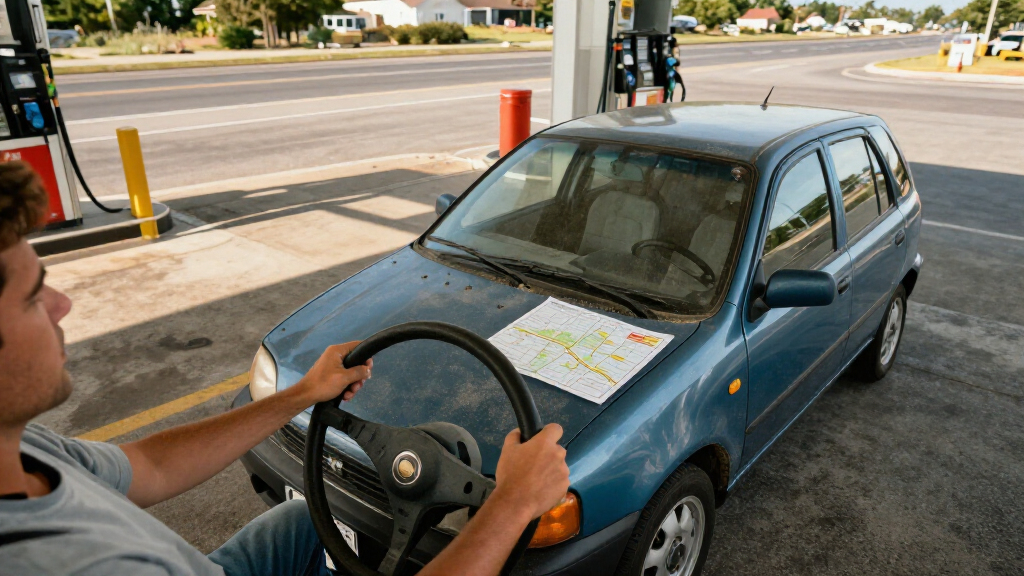
The car was a first-generation Geo Metro LSi convertible, powered by a 1.0-liter, three-cylinder engine. The report says the engine made 55 horsepower when new; Kohrmann’s pre-trip dyno test measured 43 horsepower at the wheels. He estimated that the car would have the equivalent of about 26 horsepower at the elevations encountered in the Rocky Mountains. That altitude figure is his estimate, not a separately reported measurement during the drive.
The total distance and elapsed time reported were 2,838 miles and 49 hours, 11 minutes, 18 seconds. The source does not say that Kohrmann set or claimed an official Cannonball record. It presents the drive as a personal, deliberately low-powered trip that contrasts with attempts focused on maximizing cross-country speed.
A Slower Take on the Cannonball
The drive recasts a familiar cross-country challenge around simplicity rather than speed. According to The Drive’s account, Kohrmann did not use the kind of specialized vehicle and support measures associated with record-focused runs. That distinction matters because it gives readers a concrete example of someone borrowing the route and format of the Cannonball without presenting the trip as a record attempt.
The approach does not make the journey risk-free. The Drive points out that the Metro is a small, decades-old car without the array of airbags and modern crash-protection features found in newer vehicles. A long highway trip in such a car raises safety concerns, even when the goal is not to drive at record pace. The report does not provide enough information to independently assess Kohrmann’s speed, driving practices, or the risks encountered along the way.
The trip also illustrates the trade-offs behind the Metro’s reputation: modest power and a small, economical design in exchange for limited performance. Its reported time is a measure of one documented journey, not a recommendation for others to repeat the route or a comparison with a standardized race.
Products Worth Considering

Chemical Guys 14-Piece Arsenal Builder Car Wash Kit with Foam Blaster

Chemical Guys HOL123 Car Cleaning Kit – 14-Item Interior & Exterior Detailing Set

Chemical Guys 16-Piece Arsenal Builder Car Wash Kit with Foam Cannon & Bucket
As an affiliate, we earn on qualifying purchases.
The Metro Behind the Trip
The first-generation Geo Metro was sold for model years 1989 through 1994, according to The Drive. It was a rebadged Suzuki Cultus and came in different configurations, including the LSi used for this trip. The report says the LSi’s 1.0-liter engine was rated at 55 horsepower from the factory; a separate XFi version was tuned with fuel economy in mind.
The Metro was known for low cost and fuel efficiency. The Drive cites period testing that put some configurations at up to 50 miles per gallon, and says the car sold for just under $10,000 when new. Those details help explain why the model suits Kohrmann’s low-budget framing, but the reported trip account does not give its actual fuel economy or total fuel expenses.
A successor arrived for the 1995 model year and remained in production through 2001. General Motors later applied Chevrolet branding as it wound down Geo, a marque used to sell rebadged Japanese cars. The cross-country vehicle, however, was the earlier 1992 Geo-badged model.
““everyman’s Cannonball””
— Mitchell Kohrmann, as quoted in The Drive’s account of his video
Trip Details Still Missing
The source reports the distance and elapsed time but does not include a full trip log. It is unclear how the elapsed time was calculated, how long Kohrmann stopped, what route he followed between the endpoints, or how the car performed at each stage. The account also does not provide receipts or other documentation for fuel use and costs.
The reported figures should not be read as proof of an official Cannonball record. The source describes a personal run and gives no formal record-keeping process, independent timing verification, or comparison with a named record category. It also does not detail the car’s safety equipment or any incidents during the drive.
The Video Holds the Record
The Drive points readers to Kohrmann’s YouTube video, titled How Fast Can I Cross America in a 43HP Car? (2,838 Miles), as the underlying account of the journey. Readers seeking more detail can use the video to review what Kohrmann shared about the drive; the supplied report does not identify a planned follow-up, a new attempt, or a formal record submission.
Unless Kohrmann or another source publishes additional documentation, the confirmed details remain the reported endpoints, distance, elapsed time, and the Metro’s measured wheel-horsepower figure. Whether a fuller trip log will be released is not established by the source.
Key Questions
How long did the Geo Metro trip take?
The Drive reports an elapsed time of 49 hours, 11 minutes and 18 seconds for the drive from Manhattan to Los Angeles.
How much power did the car make?
The 1992 Metro’s 1.0-liter engine was rated at 55 horsepower from the factory. Kohrmann’s pre-trip dyno test measured 43 horsepower at the wheels. His estimate of about 26 horsepower at Rocky Mountain elevations was not presented as an in-trip measurement.
Was this an official Cannonball record?
The report describes it as Kohrmann’s personal “everyman’s Cannonball,” but does not say that it was an official record attempt or provide independent verification of the time.
Where did the trip start and finish?
According to The Drive, Kohrmann started at the Red Ball Garage in Manhattan and finished at the Portofino Inn near the Pacific Ocean in Los Angeles.
Source: thedrive.com