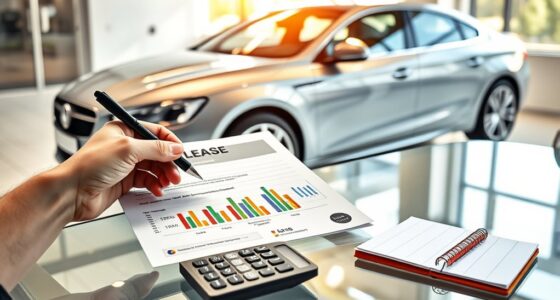
A lease vs loan calculator helps you compare the costs of leasing or financing a vehicle by factoring in residual value, interest rates, loan terms, down payments, and mileage limits. It breaks down monthly payments and total costs, making complex calculations easy to understand. By adjusting these variables, you’ll see which option fits your budget best. Keep going to discover how these factors impact your decision and find the most affordable choice.

Get business pricing on garage and car supplies
- Business-only prices and quantity discounts
- Tax-exempt purchasing
- Multiple users, one account, clear invoices
Key Takeaways
- Use a lease vs loan calculator to compare total costs, including monthly payments, residual values, and interest rates.
- Adjust variables like loan term, down payment, and mileage limits for tailored financial scenarios.
- Understand how residual value impacts leasing costs and how interest rates affect overall payments.
- Input your specific details to see which option offers greater savings and aligns with your budget.
- Use the tool to make informed decisions by visualizing differences in long-term costs between leasing and financing.

Deciding between leasing and taking out a loan for a vehicle can be confusing, but using a lease vs loan calculator simplifies the process. When you’re trying to compare the two options, understanding key factors like residual value and interest rates can make all the difference. A lease calculator helps you break down these elements, giving you a clearer picture of what each option will cost over time.
Residual value plays a vital role in leasing. It’s the estimated worth of the vehicle at the end of your lease term. When residual value is high, your monthly payments tend to be lower because you’re financing a smaller portion of the car’s depreciation. Conversely, if the residual value is low, your payments will likely be higher, as you’re covering more of the vehicle’s decline in value. A lease vs loan calculator takes this into account, allowing you to see how residual value impacts overall costs. It’s especially useful because residual values can vary based on the make, model, and even market conditions, so having a tool that adjusts for these variables helps you make an informed decision.
Residual value impacts monthly payments and overall costs, varying by make, model, and market conditions.
Interest rates are another essential factor when evaluating loans. They determine how much extra you’ll pay over the life of the loan. A higher interest rate can markedly increase your monthly payments and the total amount paid for the vehicle. When using a lease vs loan calculator, inputting the current interest rates can help you compare how much you’ll pay in each scenario. For loans, this directly affects your monthly payments, while in leasing, the interest rate influences the lease’s money factor, which is essentially the interest rate for leasing. By comparing these, you can see which financing method is more affordable based on current interest rates.
The calculator also considers other variables like the loan term, down payment, and mileage limits, giving you an all-encompassing view of your options. It allows you to tweak these factors and see how they impact your monthly payments, total cost, and overall affordability. Understanding financial concepts such as residual value and interest rates can help you make smarter decisions when comparing leasing and financing options. This way, you avoid surprises and can choose the most financially advantageous route.
In the end, a lease vs loan calculator is a powerful tool that simplifies complex financial calculations into an easy-to-understand format. It empowers you to compare different scenarios based on residual value, interest rates, and other key factors, helping you make a confident decision tailored to your budget and driving needs.
vehicle lease vs loan calculator
As an affiliate, we earn on qualifying purchases.
As an affiliate, we earn on qualifying purchases.
Frequently Asked Questions
How Do Lease and Loan Interest Rates Compare Over Time?
Interest comparison shows that lease rates are typically lower initially but can fluctuate with market conditions, leading to unpredictable rate fluctuations. Loan interest rates often stay consistent over time, especially with fixed-rate loans. Over the long term, loans might cost more if rates rise, whereas leases benefit from lower starting rates. You should consider how rate fluctuations could impact your payments and choose based on your financial stability and plans.
Can I Switch From Leasing to Buying Mid-Term?
Think of switching from leasing to buying mid-term like changing gears in a car—you can do it, but it takes effort. Usually, you can request a lease transfer or ownership transfer, but it depends on your lease agreement and lender policies. Contact your leasing company early; they’ll guide you through the process. Just be aware, some fees or penalties might apply, so review your contract carefully before making the switch.
What Are the Hidden Costs in Leasing Versus Buying?
When leasing, watch out for hidden costs like early termination fees and excess mileage charges. Buying involves depreciation costs, which reduce the vehicle’s value over time, and you might face unexpected repair expenses once warranties expire. Residual value affects your lease payments, so if it’s underestimated, you could pay more. Both options have costs beyond monthly payments, so crunch the numbers carefully to avoid surprises.
How Does Credit Score Affect Lease and Loan Options?
Your credit score impact plays a big role in your lease and loan options. A higher score improves your approval odds, making it easier to get favorable terms and lower interest rates. Conversely, a lower credit score may limit your choices and lead to higher costs. Keep your credit in good shape to maximize your chances of approval and secure better leasing or borrowing conditions.
Are There Tax Benefits for Leasing or Financing?
Did you know that leasing can offer significant tax benefits? When you lease, you might deduct your monthly payments as business expenses, and depreciation benefits are often included for leased equipment or vehicles. Similarly, financing allows you to claim tax deductions through interest payments and depreciation. So, whether you lease or finance, understanding these tax benefits can help you save money and make smarter financial decisions.
Conclusion
Now that you’ve crunched the numbers with the lease vs. loan calculator, you’re practically a financial wizard! Remember, the right choice can save you thousands and keep your wallet happier than ever. Don’t let confusion hold you back—arm yourself with these insights and make the smartest decision possible. Whether you lease or buy, you’re now equipped to conquer the world of car payments like a true champion. Your perfect ride is just a calculation away!
Fall Picks
fall essentials
As an affiliate, we earn on qualifying purchases.