TL;DR

Get business pricing on garage and car supplies
- Business-only prices and quantity discounts
- Tax-exempt purchasing
- Multiple users, one account, clear invoices
Car diagnostic scan tools connect to a vehicle’s onboard diagnostics system to retrieve supported trouble codes and, depending on the car and tool, live data and test results. A code points to a detected condition; it does not prove which part has failed. Check your vehicle’s coverage before buying a scanner, save the results before clearing anything, and use further testing or a qualified mechanic when the problem affects safety.
A check-engine light can turn a quiet commute into a guessing game. A small scanner may tell you the engine computer recorded a fault in seconds, but that result doesn’t automatically mean you need the part named in a code description.
Car diagnostic scan tools connect to your vehicle’s onboard diagnostics system to retrieve information about detected problems. Depending on the car and the tool, you may also see live sensor readings, test results, and faults from systems such as the brakes or airbags. That range matters: a basic reader and a professional diagnostic platform can look similar in an online listing while offering very different access.
This guide explains what a scan tool can tell you, how to choose one for your car, and how to use the results without mistaking a clue for a diagnosis. You’ll also learn when it makes sense to stop scanning and hand the job to a qualified mechanic.
Check scanner compatibility by make, model, year, and the exact system or function you need.
Treat a trouble code as evidence of a detected condition, not proof that the named component has failed.
Save codes and available freeze-frame data before clearing anything.
Clearing codes can reset emissions readiness monitors, even if the warning light stays off for a while.
Use a qualified mechanic for safety-critical brake or airbag repairs and specialized high-voltage EV work.
What a scan tool can tell you before you buy parts
A car diagnostic scan tool communicates with a vehicle’s onboard diagnostics system to retrieve supported trouble codes and other data. A simple reader may show an emissions-related engine code, while a more capable scanner might also display live sensor readings or results from system tests. Those extra readings help put a code in context: a sensor value that changes when the engine warms up, for example, can point toward a different cause than one that stays fixed. Access to more data can narrow the investigation, but it still takes interpretation and testing to confirm a fault.
For example, a code related to an oxygen sensor doesn’t prove the sensor has failed. The code describes a condition the computer detected, such as a reading outside an expected range. A damaged wire, exhaust leak, or separate engine problem can produce that condition too. Replacing the sensor without checking those possibilities can waste money and leave the original problem unresolved. Think of the code as a smoke alarm: it tells you something needs attention, but you still have to find where the smoke is coming from.
In the United States, most 1996-and-newer cars and light trucks use the standardized OBD-II connector and provide emissions-related diagnostic data. Requirements in other regions began on different schedules, and supported features vary by vehicle. A connector that physically fits your car does not guarantee a scanner can communicate with every system or show every function. In practice, the tool may read engine codes while being unable to access a separate brake or airbag computer.
That distinction can save you money. If your scanner reports a sensor-related fault, record the code and note when it appeared before buying a sensor. A technician may compare the code with service information and live data, then use wiring diagrams, a multimeter, and inspection to identify the actual cause. The code helps focus that work; it does not replace it.
Products Worth Considering

Autel MaxiCheck MX808S Bidirectional OBD2 Diagnostic Scanner
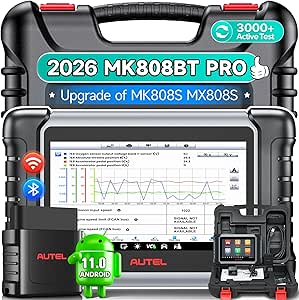
Autel MaxiCOM MK808BT PRO Bidirectional OBD2 Diagnostic Scanner

Innova 5610 OBD2 Bidirectional Scan Tool
As an affiliate, we earn on qualifying purchases.
Choose a scanner that fits your car and your plans
The right car diagnostic scan tool is the least costly option that covers your vehicle’s make, model, year, systems, and the jobs you expect to do. Basic readers often retrieve generic powertrain codes, while higher-capability tools can access more systems or run additional tests. The tradeoff is that broader access usually brings higher purchase or subscription costs, and the results may require more skill to interpret. If your 2012 hatchback only needs occasional check-engine-light checks, a basic reader may be enough; if you repair several makes, broader coverage could matter more.
| Tool type | What it often does well | What to check |
|---|---|---|
| Basic handheld reader | Retrieves and may clear generic engine codes | Often limited to emissions-related powertrain data |
| Bluetooth or Wi-Fi adapter | Pairs with a phone app for codes and some live data | App quality, privacy, subscriptions, and compatibility |
| Enhanced consumer scanner | May read additional systems and offer service functions | Coverage for your exact vehicle and function |
| Professional platform | Can offer broad access and active tests | Cost, software updates, and skill needed to interpret results |
Before ordering, search the maker’s coverage list for the exact vehicle and function you need. “All-system” on a product page doesn’t guarantee that ABS or airbag diagnostics work on every trim. Confirming the function matters because a scanner may communicate with a system but still lack a particular test or service procedure. Also check ongoing costs: updates and special features may require subscriptions, and some vehicle access depends on manufacturer authentication or an internet connection. A low upfront price can cost more over time if essential functions require paid updates, while an expensive tool may be poor value if you only need occasional code reads.
Follow these steps to get useful results from a scan
To get useful results, connect the scanner according to its instructions, retrieve and save the available information, then compare it with what your car is doing. Start with the ignition and engine state the tool maker recommends; some checks require the engine to run, while others do not. A careful record gives you or a mechanic a better starting point than a code you cleared and can no longer retrieve. The conditions matter because a fault may appear only at a particular temperature, speed, or engine load, and a code alone may not preserve that context.
- Confirm compatibility. Check your scanner’s vehicle list before plugging it in, especially if you want to read ABS, airbag, or transmission systems. A failed connection to one system does not necessarily mean the vehicle has no fault; the scanner may simply lack access.
- Note the symptoms. Record whether the engine is cold or warm, how fast you were driving, and whether the car hesitated, stalled, or made a new noise. Symptoms help distinguish between possible causes that can produce similar codes.
- Read and save codes. Photograph the display or write down each code and any available freeze-frame data, which can capture vehicle conditions when a fault occurred. Keep the exact code and description because a shortened app summary can leave out useful detail.
- Research before acting. Use reliable repair information to understand what the code describes, then investigate likely causes rather than ordering the first part suggested online. Check whether the code identifies a circuit, performance condition, or system; those descriptions imply different next checks.
- Clear only when appropriate. A code reset can erase useful evidence and reset emissions readiness monitors, so don’t clear codes just to make the warning disappear. If a shop needs to reproduce the fault, clearing it can make that harder and may delay diagnosis.
Picture a sedan that hesitates only after sitting in traffic. A code read in a cool driveway might not tell the whole story, but saved conditions and a clear symptom note can help a technician reproduce the issue. That small bit of context can save time compared with arriving with only a vague “check-engine light” description.
Know why clearing the check-engine light isn’t a repair
Clearing a code erases or resets stored diagnostic information; it does not repair the cause that triggered the warning. If the underlying fault remains, the vehicle may detect it again and switch the light back on. Resetting can also clear readiness monitor results, which means the car may need to complete certain driving conditions before those emissions checks run again. Until a monitor completes, you have less information about whether that part of the emissions system has passed its self-check.
That matters if you plan to have an emissions inspection soon. A driver might clear a light on Friday, see it stay off for a short trip, then find that the vehicle’s monitors have not completed when testing time arrives. The light’s absence alone doesn’t tell you the original issue has gone away: the computer may simply not have run the test that would detect it again. Inspection rules vary, so an incomplete monitor can create a practical delay even when the car seems to drive normally.
Save the codes and available freeze-frame details before clearing anything. Those records may show what was happening when the computer detected a fault, such as engine temperature or speed. That information can help narrow down intermittent problems that are difficult to reproduce. Clearing the data too early is like wiping a useful note off a mechanic’s workbench before anyone has read it.
A code is a lead, not a repair plan. Find out what the vehicle detected, preserve the evidence, and test the cause before replacing parts or resetting the warning.
If the car runs roughly, stalls, or shows a warning that concerns you, don’t treat a cheap reader’s clear button as a fix. A scan can help you describe the problem, but a mechanic can inspect and test the system that set the code. If a warning returns after a reset, that is evidence the problem may still be present, not a reason to keep clearing it.
Use extra care with ABS, airbag, hybrid, and EV faults
Safety-system and high-voltage faults need the right equipment and training because a basic scan tool may not access them—or safely support the work that follows. Many simple readers focus on generic engine and emissions data. ABS, airbag, transmission, hybrid, and electric-drive information can depend on the vehicle, scanner, software, and manufacturer access. This matters because a scan result is only useful if the tool can reach the relevant control module, and access alone does not make a repair safe.
For instance, a basic reader that finds an engine code on a family car may show nothing useful about an ABS warning on the same vehicle. A scanner that does support the braking system could still report a fault that needs further inspection and testing. A warning may affect how a safety feature operates, so an empty scan result from an incompatible reader should not be treated as reassurance. Check the tool’s coverage for your exact car before assuming it can read a dashboard warning.
Hybrid and electric vehicles need particular care. Some generic tools can retrieve general vehicle data, but high-voltage battery and electric-drive diagnosis often needs specialized equipment and training. High-voltage components can remain dangerous even when the vehicle is switched off, so a routine code-reading skill does not qualify someone to open a battery pack or handle its wiring. If a fault involves those systems, don’t open battery components or handle high-voltage wiring yourself.
Take airbag and brake warnings seriously. A qualified mechanic can diagnose safety-critical repairs, and you can check your vehicle for open recalls through the National Highway Traffic Safety Administration’s recall lookup. A scan result can help you explain the issue when you call; it doesn’t replace professional inspection of brakes, airbags, or high-voltage equipment. If you are unsure whether the vehicle is safe to drive, ask a qualified professional for guidance before continuing to use it.
Decide when your scan result needs a mechanic
A scan tool is most useful when you use it to gather information and recognize when the next step calls for more than a code lookup. If the car behaves normally and the code points to an emissions-related fault, you can save the result, check trustworthy vehicle-specific information, and arrange suitable follow-up. This gives you time to gather evidence without assuming the part named in a code is the cause. If the vehicle runs badly or a safety warning appears, contact a qualified mechanic instead of relying on a reader to settle the question; further driving could worsen a fault or leave a safety system unavailable.
- Write down symptoms such as a rough idle, burning smell, unusual noise, or reduced power, along with when they occur. A pattern can help a technician reproduce an intermittent fault.
- Share every code and any freeze-frame data with the repair shop; don’t clear them first. More complete information can reduce guesswork and avoid repeating checks.
- Ask what the code confirms and what additional inspection or test would identify the cause. This helps distinguish a confirmed failure from a plausible cause that still needs evidence.
- Check coverage and costs before buying an upgraded scanner for ABS, airbags, or a specific service function. The extra features are useful only if they support your vehicle and the job you plan to do.
- Leave safety-critical work involving brakes, airbags, or high-voltage systems to certified or otherwise qualified professionals. A code reader does not make those repairs safe to attempt without the right training and equipment.
Say your car’s engine light turns on after a long drive, but the car feels normal. A saved code and a note about the drive give a shop a more useful starting point than a cleared light. If the brake pedal suddenly feels soft or the airbag warning appears, treat that as a separate safety issue and get professional help promptly.
Think of a scanner as a flashlight. It can help you see where to look, but it doesn’t fix what’s broken or tell you every detail about the hidden parts. The best result comes from matching the tool to the vehicle, preserving what it finds, and acting on the evidence with care.
Frequently Asked Questions
What does an OBD-II scanner do?
An OBD-II scanner connects to a vehicle’s diagnostic system to retrieve supported trouble codes. Depending on the car and tool, it may also show live sensor readings or test results. A basic reader generally focuses on generic powertrain and emissions information.
Can a scan tool tell me exactly what is wrong?
Usually, no. A code describes a condition the vehicle detected, and more than one problem can cause that condition. For example, an oxygen-sensor-related code could involve wiring or an exhaust leak as well as the sensor itself.
Will a cheap scanner work on my car?
It may read generic engine and emissions codes if both the vehicle and scanner are compatible. It may not reach ABS, airbags, transmission, or manufacturer-specific functions. Check the scanner’s coverage list for your exact year and model before buying.
Can I clear a code to turn off the check-engine light?
Many scanners can clear stored codes, but clearing does not fix the fault. The light may return if the problem remains, and the reset can erase useful data and emissions readiness results. Save the information before clearing anything.
Can a basic reader diagnose ABS or airbag problems?
Often it cannot; basic readers commonly focus on emissions-related powertrain codes. ABS and airbag access depends on the specific scanner and vehicle. Since brakes and airbags affect safety, have a qualified mechanic handle repairs in those systems.
Can I use a car scanner on an electric vehicle?
Some tools can read general vehicle data, but EV battery and electric-drive diagnosis often requires vehicle-specific equipment and training. Don’t open or work on high-voltage components without appropriate qualifications. Check both the tool maker’s coverage and the vehicle maker’s service guidance.
Conclusion
Use a scan tool to gather better evidence, not to guess at parts or hide a warning light. Check that it supports your vehicle, save its findings, and match the next step to the symptoms and system involved.
A trouble code can point the way. Let careful testing tell you what’s actually wrong.