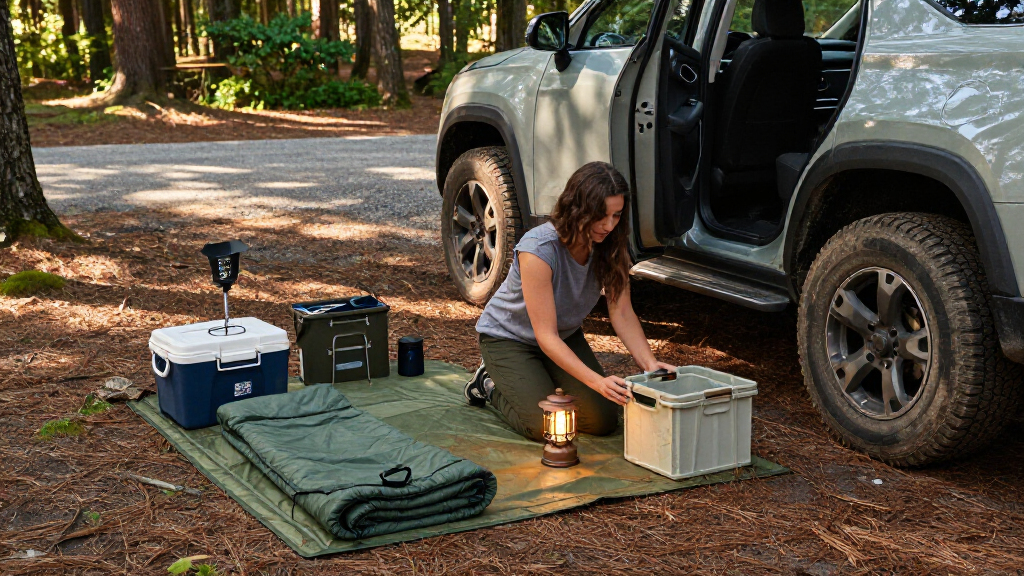

This checklist is for drivers planning overnight trips where the vehicle is part of the campsite. It covers gear for cooking, sleeping, food storage, privacy and airflow, with car-specific fit in mind.

Get business pricing on garage and car supplies
- Business-only prices and quantity discounts
- Tax-exempt purchasing
- Multiple users, one account, clear invoices
Each section focuses on one gear slot. Where a product is listed, the guidance helps you assess whether it suits your vehicle and trip; where no product is listed, the section offers selection advice without naming a pick.
Start with your vehicle’s layout, the number of people traveling and the space available for gear. Check dimensions and compatibility before buying, and use the look-for points as a quick comparison list.
Car Roof Tent
A roof tent can add a dedicated sleeping space while keeping the cabin available for gear, but the key question is whether the tent and vehicle are compatible. Check your vehicle’s roof load guidance and the capacity and fit of its roof rack before narrowing down options. Vehicle compatibility comes first; a tent’s listed sleeping capacity does not tell you whether it fits your setup.
A common mistake is choosing by sleeping space alone. Consider how the tent opens, whether it clears the hatch or doors, and how much room you need to access the vehicle. Compare the tent’s packed dimensions with your storage plan, and check how its mounting system attaches to your rack. For a lease, review any relevant vehicle and rack requirements before installation, and favor a setup that can be removed without altering the car.
Think through your usual campsite, too. A tent that is awkward to deploy or blocks access to essentials may not suit frequent stops. Confirm the included components and instructions, then plan where bedding and other items will go when the tent is closed. Measure first and make sure the complete setup works with your vehicle, rack and travel routine.
What to look for:
- Compatibility with your vehicle and roof rack
- Roof load guidance for the vehicle and rack
- Mounting system and installation requirements
- Open and packed dimensions, including hatch clearance
- Whether the tent can be removed for your lease and storage needs
Hatchback Privacy Tent
A hatchback privacy tent can extend the usable space around an open rear hatch and offer a more private place to change or organize gear. The first check is the shape and opening of your vehicle’s rear hatch: tent sleeves, attachment points and coverage need to match the car. Hatch compatibility matters more than a broad description such as “universal.”
Look closely at the dimensions and how the tent attaches. Compare the listed opening size with your hatch and check whether the design relies on straps, magnets or another connection method. A common buying mistake is assuming a tent will seal or stay in place without checking the attachment details. Consider where the fabric falls around the bumper and whether it leaves access to items you need inside the vehicle.
Think about your intended use and campsite layout. A privacy tent may need room behind the car to extend fully, so check the footprint against the space you typically have available. Review how it packs away and whether its packed size fits your storage area. Test the layout on paper by comparing the tent dimensions with the hatch and the space behind your car, then verify the attachment method before selecting one.
What to look for:
- Fit for your hatch shape and opening dimensions
- Attachment method and the vehicle surfaces it uses
- Coverage around the hatch, bumper and sides
- Setup footprint and clearance behind the car
- Packed dimensions and storage needs
Portable Camping Stove
The Coleman Cascade 3-in-1 Portable Camp Stove with Grill and Griddle brings several cooking surfaces into one gear choice, so it can suit trips where meals vary. Before buying, check the configuration details and what components are included; the product name alone does not establish which accessories come in the box. Included components help you avoid planning around a cooking surface that is not part of your setup.
A common mistake is overlooking where the stove will be used and stored. Compare its packed dimensions with your available cargo space, and consider how much level surface you can provide at camp. Review the manufacturer’s operating and fuel guidance, including any clearance requirements, before use. Do not assume that a stove can be used inside the vehicle or in an enclosed space; follow its instructions and campsite rules.
Think through your usual meal plan. The grill and griddle options may be useful if you want different styles of cooking, while a simpler setup may be easier to pack if you prepare fewer meals at camp. Confirm the stove’s setup process, cleaning guidance and parts before leaving home. Plan the cooking space alongside food, utensils and fuel storage so the stove fits into the overall car-camping layout.
What to look for:
- Included grill and griddle components
- Packed dimensions and cargo-space fit
- Manufacturer’s fuel, setup and clearance instructions
- A stable, level cooking surface at camp
- Cleaning requirements and storage for parts
Coleman Cascade 3-in-1 Portable Camp Stove with Grill and Griddle
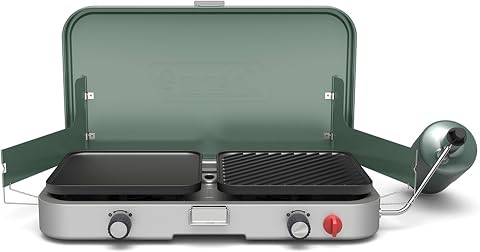
This portable propane camp stove includes removable cast-iron grill and griddle accessories for versatile outdoor cooking. Two adjustable burners provide up to 24,000 BTUs, with rotary ignition, wind guards, and controls for temperature and simmering.
Pros:
- Includes removable cast-iron grill and griddle for varied cooking
- Two adjustable burners offer temperature and simmer control
- Wind guards help shield the burners and flame
- Recessed handle and accessory carry case support transport
Cons:
- Propane cylinder is sold separately
- Burn time is up to one hour on high with a 16 oz cylinder
Best for: Campers who want grill and griddle options in one stove setup
Not ideal for: Travelers prioritizing the smallest or simplest cooking kit
Bottom line: Check included components, packed size and operating instructions before packing this stove.
Car Camping Mattress
The Exped MegaMat Auto Sleeping Pad with Wheel Cutouts is named for car-sleeping use, and the wheel cutouts make vehicle layout especially relevant when assessing fit. Compare the pad’s dimensions and cutout arrangement with the cargo area you plan to sleep in. Measure the sleeping area with seats folded or repositioned as you expect to use them; vehicle interiors vary, even within a model line.
A common mistake is relying on a vehicle’s overall cargo dimensions rather than checking the usable, flat sleeping surface. Look for measurements that account for wheel wells, seat backs and any change in floor height. Confirm the pad’s thickness and packed size against headroom and storage space, and check the maker’s inflation and care guidance. Make sure the cutouts align with the vehicle’s wheel wells rather than assuming the fit from the product name.
Consider who will sleep on the pad and how much room each person needs. Check the layout for shoulders, legs and access to the hatch or doors, especially if two people will share the space. Verify the fit at home before a trip, with the vehicle configured for sleeping and the pad positioned as intended. This helps reveal interference from seat hardware or interior contours while there is time to adjust your setup.
What to look for:
- Pad dimensions compared with your vehicle’s sleep area
- Wheel-cutout placement relative to wheel wells
- Fit around folded seats and interior contours
- Packed size and available headroom
- Inflation, care and storage instructions
Exped MegaMat Auto Sleeping Pad with Wheel Cutouts

The Exped MegaMat Auto Sleeping Pad is a 4-inch polyurethane foam mattress designed for vehicles like trucks, SUVs, and Teslas. It features asymmetrical wheel well cutouts, easy handling with welded side handles, and an advanced valve system for quick inflation and deflation, providing vehicle-optimized comfort for camping trips.
Pros:
- Custom fit for various vehicle types including trucks and Teslas
- Easy to inflate and deflate with advanced valve system
- Comfortable support with adjustable firmness
Cons:
- Designed specifically for vehicle use, less suitable for ground camping
- May be bulky to store when not in use
Best for: Car campers whose vehicle layout matches the pad’s wheel cutouts
Not ideal for: Drivers without a flat sleeping area that fits the pad dimensions
Bottom line: Check the actual sleep surface and wheel-well alignment before relying on this pad for a trip.
12V Portable Refrigerator
The BougeRV 12V Refrigerator Rocky V3.0 55QT, Dual Zone Car Freezer is identified as a 12V, 55-quart, dual-zone unit, making vehicle fit and power planning central to the choice. Check the unit’s external dimensions against your cargo area, including room for ventilation and access to its compartments. Measure the full footprint where it will ride, not just the open space visible at first glance.
A common mistake is treating capacity as the only storage consideration. Think about the shape of the food and containers you plan to pack, and check how the dual-zone arrangement is described by the manufacturer. Review the product’s power requirements and connection guidance, then compare them with the outlets or power source available in your vehicle. Do not assume a 12V connection will work with every setup without checking the specified requirements.
Plan where the refrigerator will sit while parked and while traveling. Ensure it can be secured according to its instructions and that the lid or compartments can be opened without moving other gear. Check ventilation guidance and the packed layout with luggage loaded. Plan power and placement together so the unit is accessible, fits safely in the cargo area and can be used as directed throughout the trip.
What to look for:
- External dimensions and cargo-area clearance
- 55-quart capacity against the food you plan to carry
- Manufacturer details for dual-zone use
- 12V power requirements and connection guidance
- Ventilation, access and secure placement instructions
BougeRV 12V Refrigerator Rocky V3.0 55QT, Dual Zone Car Freezer

The BougeRV Rocky V3.0 is a portable 55-quart refrigerator suitable for road trips, camping, and outdoor adventures. It features dual or single zone temperature control, app connectivity, and compatibility with a detachable battery for extended use.
Pros:
- Flexible dual or single zone temperature control
- App control for easy adjustments and monitoring
- Compatible with detachable battery for extended outdoor use
- Spacious enough for 76 cans, ideal for trips
Cons:
- Battery is sold separately, adding to total cost
- Manual defrost may require maintenance
- Limited to portable use, not suitable for stationary refrigeration needs
Best for: Road trippers who want a dual-zone 12V food storage setup
Not ideal for: Campers without suitable cargo space or a compatible power source
Bottom line: Confirm dimensions, power requirements and ventilation before choosing a place for the refrigerator.
Car Window Mosquito Nets
Car window mosquito nets can help keep insects out while allowing air to move through an open window, but the fit depends on the exact window shape and opening. Check whether the net is designed to cover the whole door frame, fit over an open door or attach in another way. Window-specific fit is the first detail to confirm; a loose edge can leave gaps.
A common mistake is choosing a net based only on a vehicle’s make or general size. Compare the net’s stated dimensions with each window you plan to use, and check its attachment method against the door frame and trim. Consider whether the window can be opened to the amount the net requires, and whether the net interferes with mirrors, door seals or normal access. Follow the product’s instructions for installation and removal to avoid putting strain on vehicle surfaces.
Decide which windows need coverage and how you will use the car at camp. A front and rear window may have different shapes, so verify each one separately rather than assuming one size covers the whole vehicle. Check how the net stores between trips and whether it can be installed while the vehicle is parked as you intend. Check every opening you plan to use, then confirm the net leaves a secure, unobstructed fit around the window.
What to look for:
- Dimensions for each window you plan to cover
- Attachment method and compatibility with door frames
- Coverage at edges to limit gaps
- Clearance around seals, mirrors and access points
- Installation, removal and storage instructions
Build your checklist in a practical order: first confirm the sleeping layout and vehicle fit, then decide what you need for food storage and cooking. Add privacy and window coverage based on your campsite and comfort needs. Measure before buying, and prioritize gear that fits your vehicle and the way you plan to travel.
You do not need to assemble every category at once. Start with the items that address your trip’s essentials, check how they pack together, and refine the setup after each outing. With a little planning, car camping can feel more comfortable while keeping your gear choices focused.